6 November 2026
How to Check Your Thesis for Plagiarism: Process, Cost and What the Report Means
Your thesis is done, the deadline is close, and one question is left: should you check it for plagiarism yourself first? And if so, with what, at what cost, and what do you do with the result?
Here are the answers in the order you need them. Whether and how your university checks is covered in How Swiss Universities Actually Check for Plagiarism.
How does a plagiarism check work?
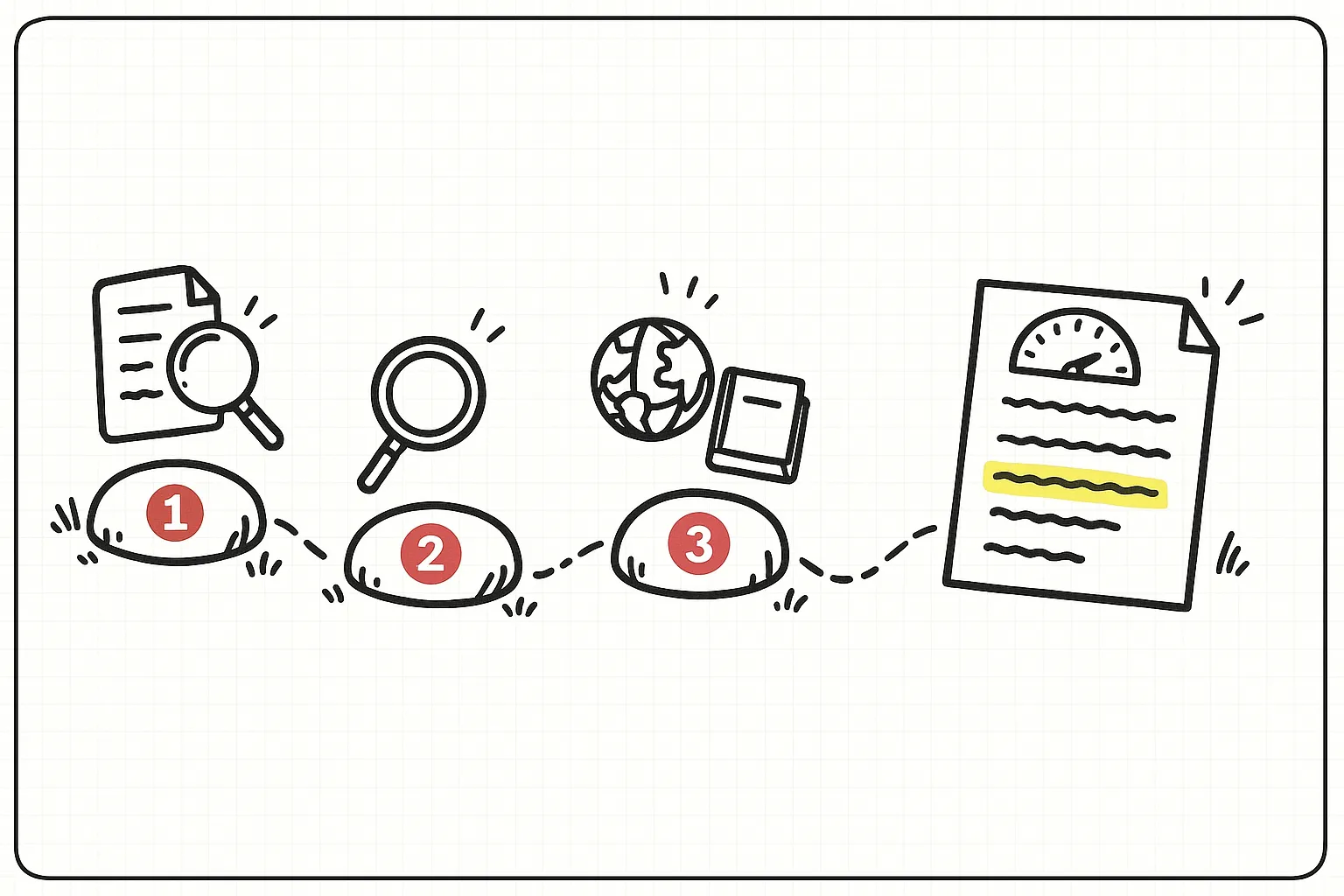
- Upload: you upload your thesis as a PDF or Word file.
- Compare: the software looks for passages that match other texts. Turnitin's student guide says it compares your writing with the internet, its own databases and other people's papers.
- Report: you get a percentage and the matching passages with their sources.
What matters is what the report is not. In the same guide, Turnitin says: "Similarity does not mean that your work is plagiarized." Whether a match is a problem is decided by a person, not by the software.
Which plagiarism checker for your bachelor's thesis?
You have three options. They differ in what your text is compared with and what happens to your file.
- Through your university: the best option if it exists, because you use the same software your supervisor will use. At the University of Zurich, students have been able to check their own work through a self-service course since 19 November 2025. According to the OLAT documentation, lecturers cannot see these uploads, only the latest version is kept, and files are deleted after six months. At ETH Zurich and the University of Bern, the software is reserved for teaching staff.
- A commercial service: for example Scribbr, priced per document by word count (see below). According to Scribbr, your thesis is not added to a public database and is deleted automatically after one month.
- PaperCheck: the plagiarism check runs in the same pass as feedback on your whole thesis. More on that below.
What this means for you: first ask whether your university offers students a self-check. If not, look for three things in any service: is your file stored, and for how long? Does the report show every match with its source? And do you have enough time left to work through the matches?
No outside tool sees everything your university sees. Universities often also compare against their own archive of earlier papers. Bern, for example, compares against its own archive of internal papers going back at least five years.
Master's thesis and term paper: what's different
The process is the same. What differs is how certain a check is:
- Master's thesis: at the University of Zurich, master's theses published in the ZORA repository must be checked. Expect a check.
- Bachelor's thesis: practice varies most here. ETH's licence covers them; at the University of Zurich, each faculty decides.
- Term paper or seminar paper: we found no general rule. ETH's licence does explicitly cover seminar papers. Assume any graded paper can be checked.
The longer the thesis, the more matches you'll have to work through. Plan more time for a master's thesis than for a term paper.
How much does a plagiarism check cost?
| Option | Cost |
|---|---|
| Your university | free, if it offers students a check |
| Scribbr Switzerland | CHF 22.95 up to 7,499 words, CHF 34.95 up to 49,999 words, CHF 44.95 from 50,000 words (as of October 2026) |
| PaperCheck | from the Plus package; the plagiarism check costs as many credits as the analysis, 1 credit per 100 words |
A PaperCheck example: a 12,000-word bachelor's thesis needs 120 credits for the analysis and another 120 for the plagiarism check. The Plus package includes 500 credits one-time or 350 per month.
Can ChatGPT check for plagiarism?
No. A chatbot doesn't compare your text with a database of published texts; it generates a plausible answer. Ask it for the sources of a passage and it may make some up.
How often that happens is well documented: in a study in Scientific Reports, 55% of the citations generated by GPT-3.5 and 18% of those by GPT-4 were fabricated, and many of the real ones contained errors.
For a plagiarism check you need software with a comparison database. What ChatGPT means for your thesis is covered in Will My Professor Know I Used ChatGPT?
What does the percentage mean?
Less than most people think. Turnitin says: "There is no fixed number to receive as a score." There is no general threshold; which matches are normal and which aren't is explained in the article on Swiss universities.
What to do with the report
Work through each match, not just the percentage:
Where PaperCheck fits
We don't replace your university's check. Our advantage is that you get the report where you work on it:
- Matches right on the page, with source, identical words and a risk level, so you can tell a cited quote from a paraphrase that's too close.
- Help next to each match: a citation generator where a citation is missing, and suggestions where you need to rephrase.
- Feedback on your whole thesis in the same pass: argument, structure and bibliography.
- AI text detection for English papers. We don't check German papers for AI, because there isn't enough solid evidence that such checks work reliably on German text.
- Privacy: at upload you can choose automatic deletion after 90 days.
More about PaperCheck's plagiarism check.
Keep reading
- How Swiss Universities Actually Check for Plagiarism
- How to Avoid Plagiarism in the AI Era
- How to Check Your Thesis Citations Before You Submit
Want to see what a similarity report says about your thesis before your supervisor does? Upload your thesis to PaperCheck: plagiarism check, source checks and feedback on argument and structure in one pass.