2 November 2026
Will My Professor Know I Used ChatGPT? What AI Detection Can and Cannot Do
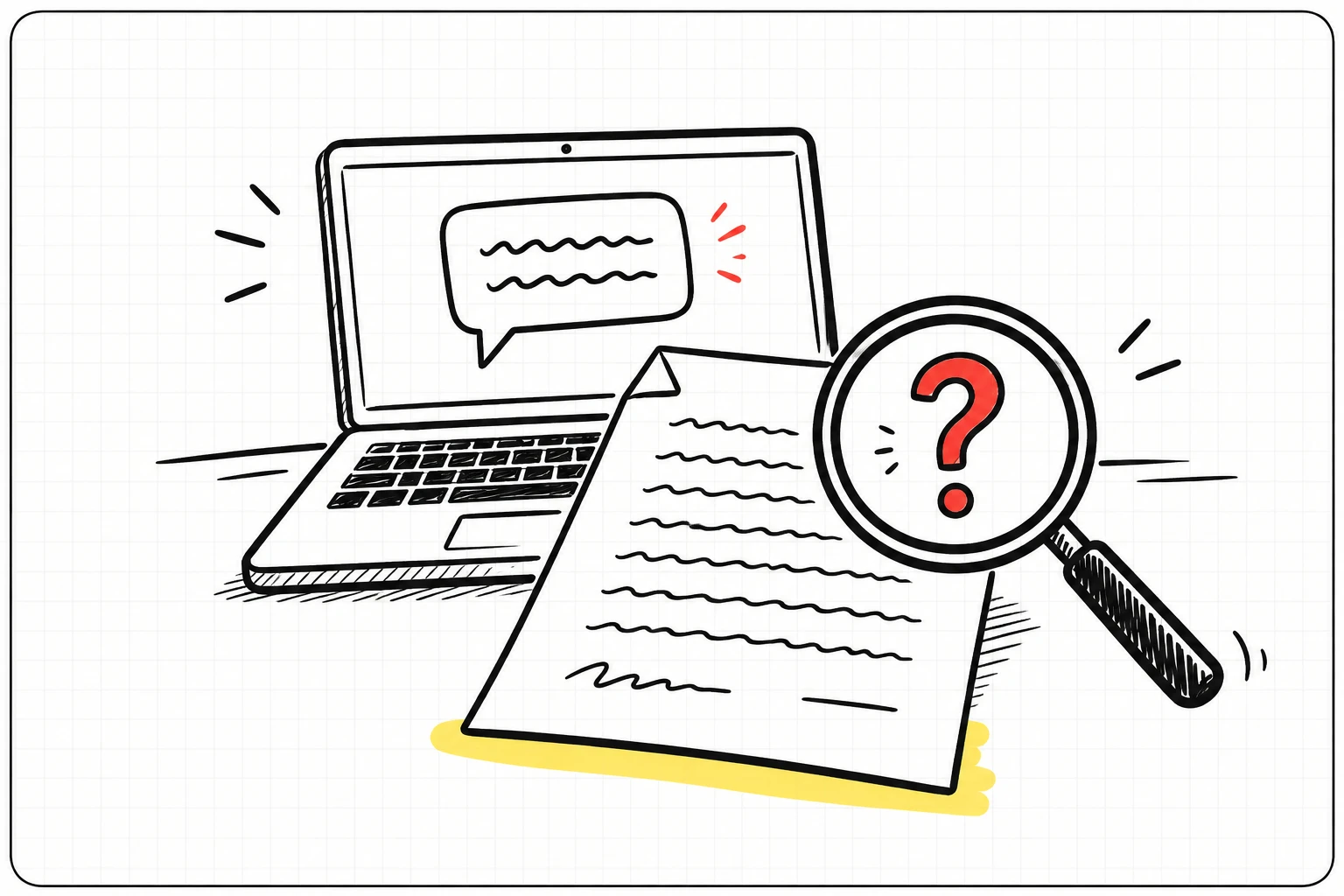
If you are searching this the week before submission, the worry is usually not that you cheated. It is that you used an AI tool somewhere reasonable (tidying a paragraph, getting unstuck on a method section, translating a source) and nobody has told you plainly whether that is a problem.
Here is the plain version, with the numbers and where they come from. It will not tell you how to avoid detection; that advice is bad for you. It will tell you what the systems do, what they get wrong, and what actually gets students into trouble, which is not what most people worry about.
What Turnitin's AI detection actually reports
Turnitin's AI writing detection gives a percentage estimating how much of a document was likely AI-generated. It is separate from the similarity report and needs at least 300 words of long-form prose.
What Turnitin publishes about itself, with the caveats:
- Under 1% false positives at document level (still published in 2026), but only for documents scored at 20% AI or above. There is no published false-positive rate for 1–19%.
- Scores from 1% to 19% show as an asterisk, not a number, because accuracy is worse there. That design decision tells you something.
- About 4% false positives at sentence level, from a 2023 post that current documentation does not restate.
- Not proof: Turnitin says it "does not make a determination of misconduct" and the score "should not be used as the sole basis for action."
You may read that "Turnitin is 98% accurate". That mixes up a "98% confidence rate" claimed at launch in 2023 with a statistic that 98% of institutional customers had the feature switched on. Turnitin publishes no headline accuracy figure today.
If your thesis is in German, none of this applies
Turnitin's AI writing detection does not support German. Its language list covers English, Spanish and Japanese, so a German thesis gets no AI writing report at all.
That is the state of the field, and it applies to us too: our own AI-text check runs on English papers only, because there is not enough evidence that these classifiers behave sensibly on German academic prose.
So at a Swiss, German or Austrian university, "will the software catch me?" has a boring answer: no software is analysing your German prose for AI authorship. What governs you is the declaration you sign.
What the research says, including the inconvenient parts
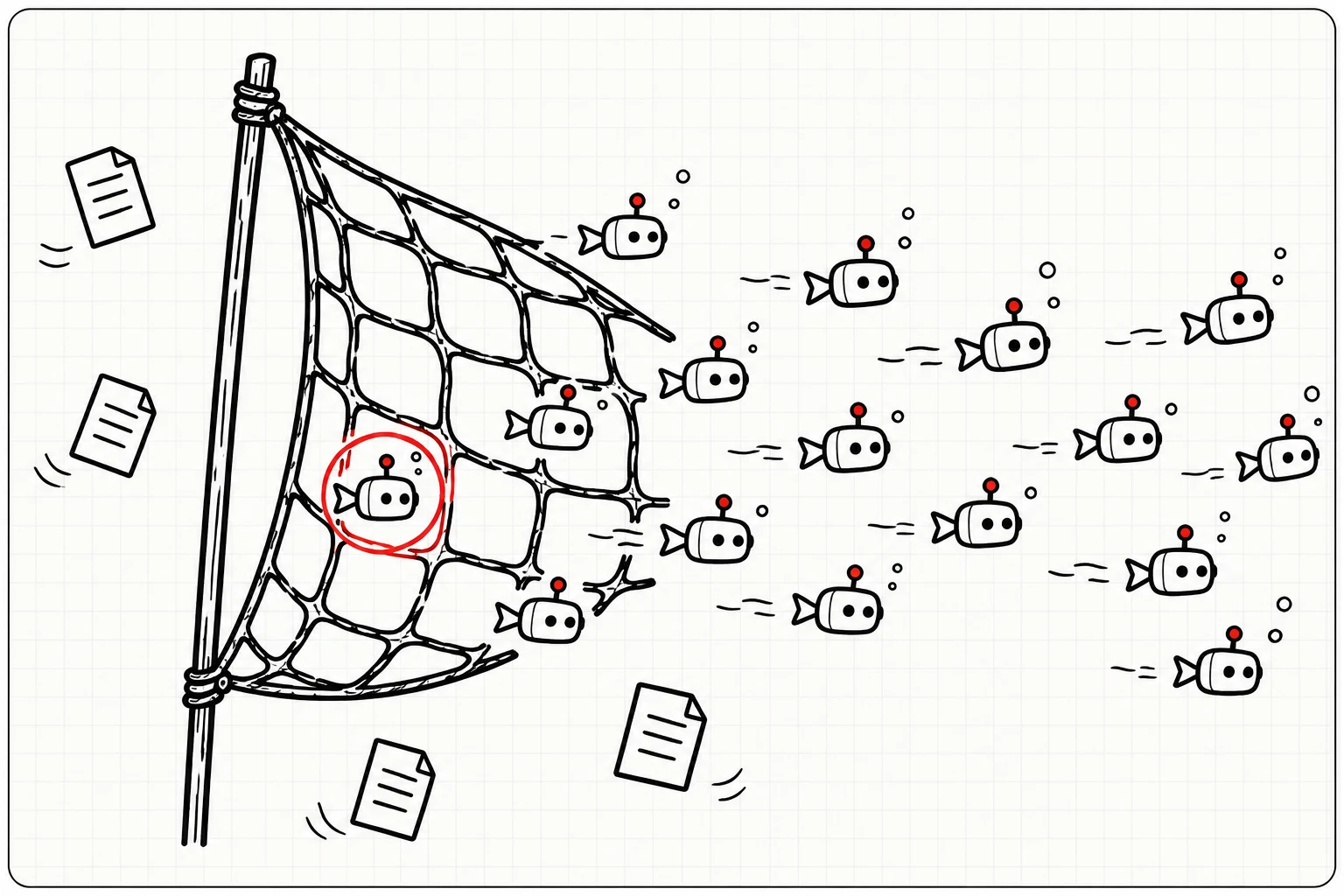
The independent evidence is mixed, and it has moved:
- 2023, the bias finding. A Patterns study ran seven detectors on 91 TOEFL essays by non-native English speakers. The average false positive rate was 61%; nearly 98% of the essays were flagged by at least one detector. The same detectors were near-perfect on essays by US school students: they were reading unfamiliar English as machine writing.
- 2023, the accuracy finding. An International Journal for Educational Integrity study tested 14 tools and found all below 80% accuracy, "neither accurate nor reliable". To be fair: it recorded zero false positives for Turnitin.
- 2026, the picture changed. A June 2026 IJEI study from Vrije Universiteit Brussel tested Turnitin, GPTZero, Copyleaks and Pangram on 160 master's-level papers (human-written, fully AI-generated, hybrid and "humanised"):
- zero false positives on human text for all four tools;
- but Turnitin, GPTZero and Copyleaks caught only 0% to 30% of fully AI-generated text, and Turnitin missed all 40 fully AI-generated papers;
- only Pangram was reliable: 97.5% on fully AI-generated and 92.5% on humanised text;
- run on 1,163 real master's theses from 2024–2025, Pangram flagged 45.5% for likely AI-associated content, mostly partial.
The honest 2026 summary is uncomfortable for everyone: these tools now fail less by accusing the wrong people and more by missing most of what they should find. "Detectors are biased, so a flag means nothing" runs on 2023 data. A flag is not meaningless; it just proves nothing on its own.
The anchor fact: OpenAI launched an AI-text classifier in January 2023 and withdrew it in July "due to its low rate of accuracy". It caught 26% of AI text and wrongly flagged human writing 9% of the time. The company that makes ChatGPT could not reliably detect ChatGPT.
Some universities have switched it off entirely
- Vanderbilt disabled Turnitin's AI detector in August 2023 and has not turned it back on. Its reasoning was arithmetic: 1% false positives on 75,000 papers a year is about 750 wrongly flagged papers.
- Yale, Michigan State and UC Berkeley have also disabled or opted out.
- Australian Catholic University dropped the tool in March 2025 after about 6,000 misconduct cases in a year, around 90% AI-related, of which about a quarter were dismissed on investigation (reported October 2025).
- The University of Kentucky kept it on, with no opt-out, while telling instructors to treat scores "with healthy skepticism".
You will also see "over 50 universities have banned AI detection". We could not trace it to a primary source; every version we found came from companies selling detector-evasion tools.
What actually gets students into trouble
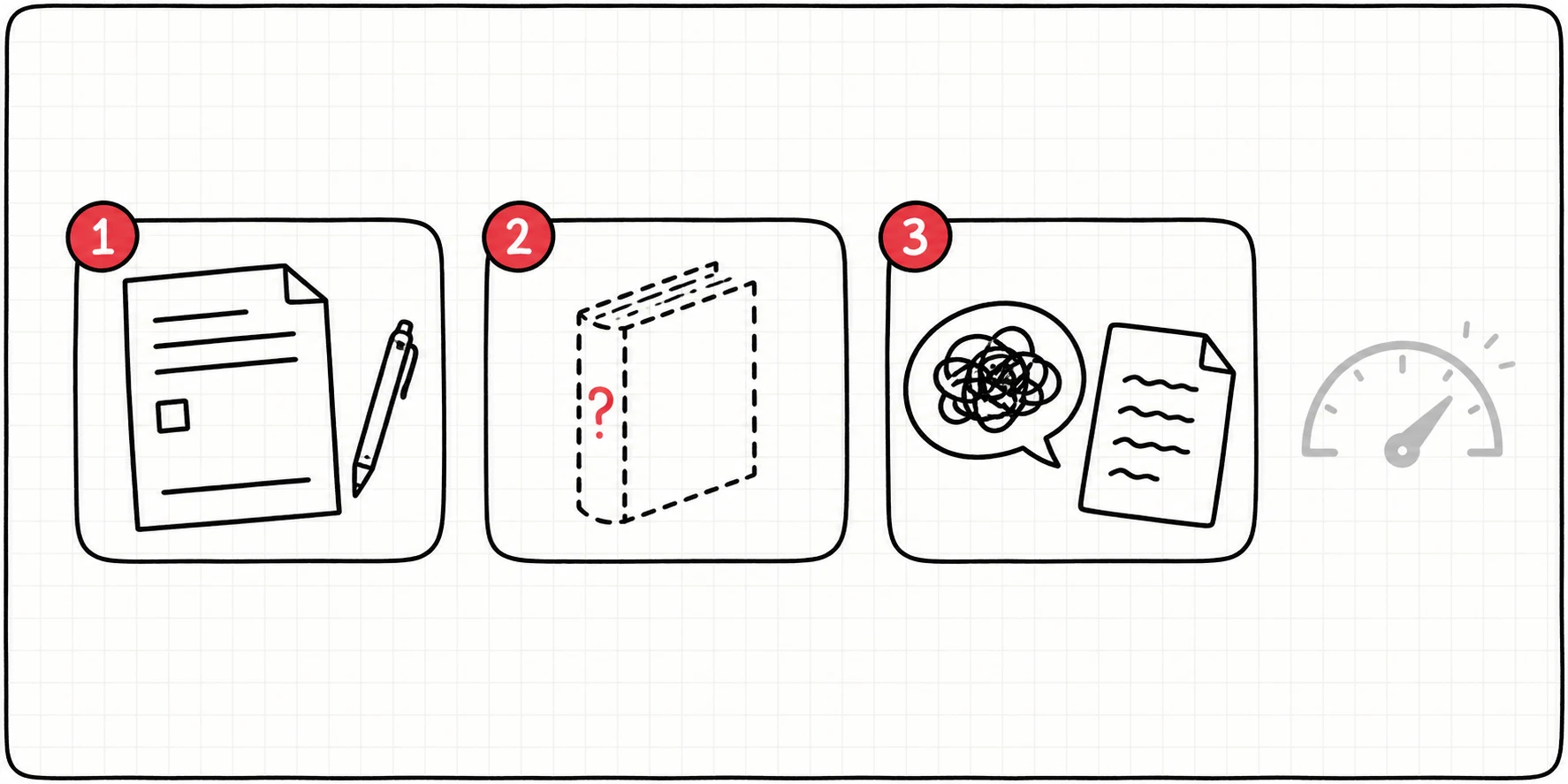
Not the detector. Three other things:
1. Undeclared use. The big one. ETH Zurich states that using AI output is not in itself plagiarism, but undeclared use "constitutes a special form of ghostwriting" and can lead to disciplinary proceedings. Universities in the German-speaking region now ask for specific declarations:
- Universität Vechta: an appendix naming each AI tool, its version and how it was used, agreed with your examiner in advance.
- MedUni Wien: a table of tools, purposes and sections in the statutory declaration, with AI tools also in the bibliography.
- UZH medical faculty: a section on AI use inside the methodology chapter.
Rules differ by country and institution, sometimes sharply; a US university may have no formal declaration at all. Find your own institution's current policy and treat that, not this article, as authoritative. It is usually one page and usually permits more than students assume.
A good declaration names the tool, the version, what you used it for, and where:
2. Invented sources. This is what actually surfaces. AI tools produce references that look real (plausible author, journal, year) for papers that do not exist. ETH requires you to verify every fact, source, link and citation yourself. No detector is needed: your examiner looks up one source they know, and it is not there.
3. Not being able to explain your own work. In a defence, nobody needs software to see that a candidate cannot explain a paragraph of their own thesis.
About "humanizer" tools
Do not.
Whether they work is a question with a short shelf life: Turnitin launched bypasser detection in August 2025, and the June 2026 study found humanised text still detectable by the best tool it tested.
But that is not the argument. Under a declaration regime, running your text through a humanizer while signing that the work is your own turns a citation question into a false formal declaration: a more serious offence than undeclared AI help, committed deliberately, in writing, with your signature.
If your writing reads as AI-generated, do not disguise it. Rewrite the passage in your own voice until you can explain every sentence. If you cannot, the passage is not ready regardless of who wrote it, and that is the test your examiner will apply.
If you are wrongly accused
It happens, and there is a process. The UK Office of the Independent Adjudicator published casework guidance in July 2025 that describes a fair procedure wherever you study:
- The burden of proof is on the institution: "the responsibility is on the provider to prove that the student has done what they are accused of doing, not on the student to disprove it."
- You are entitled to see the report, not just hear a number.
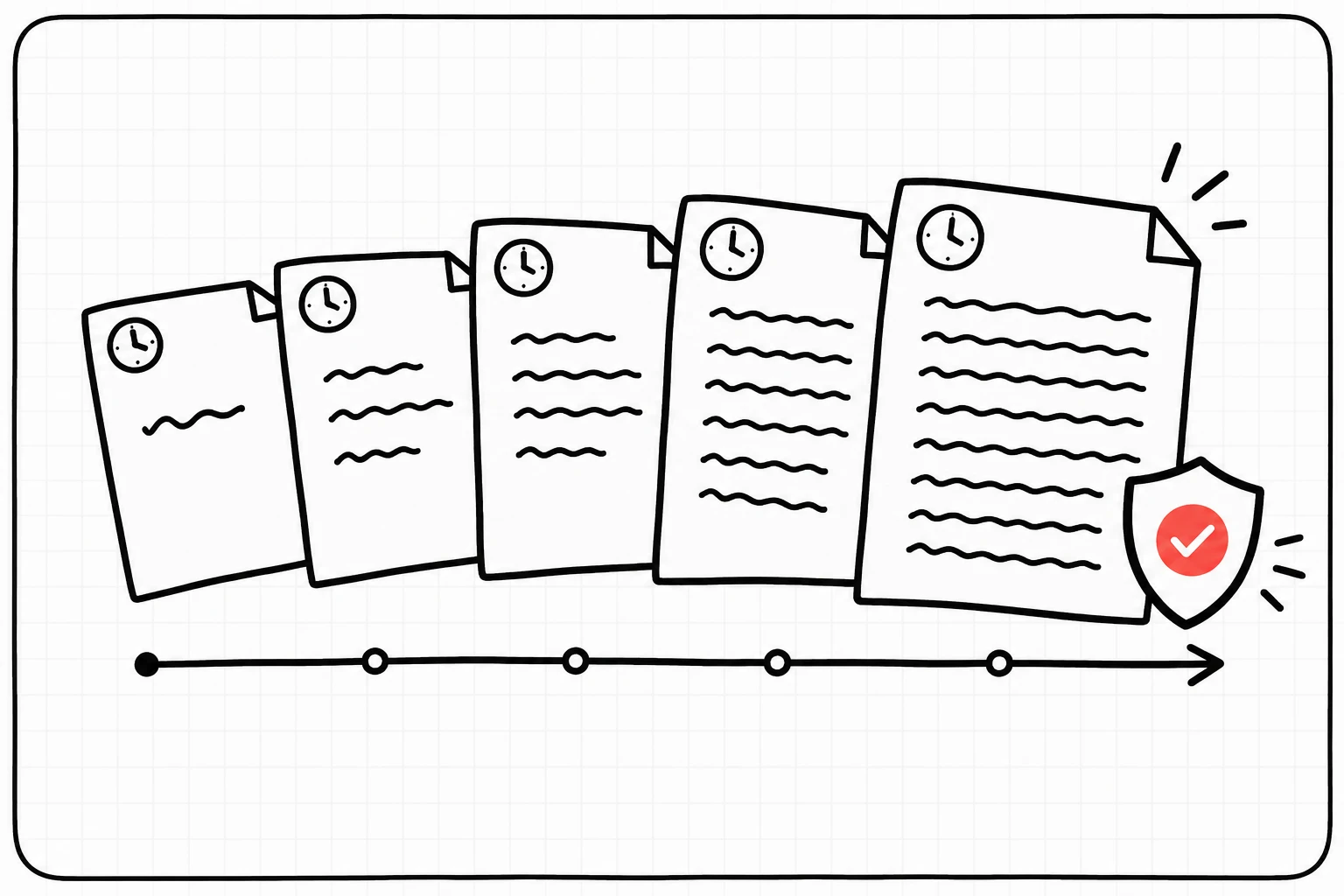
- Your drafts are evidence. You should be invited to supply notes and drafts and explain your writing process.
- Get support from a students' union adviser or equivalent.
- Detection output alone is not enough. The OIA upheld appeals where universities relied on it without looking at drafts.
The practical rule: keep your drafts and version history. Write in something that keeps revisions (Google Docs, Overleaf, Word with Track Changes, or Git). It costs nothing, and a timestamped record of what you wrote and when is exactly the evidence the process asks for.
How to use AI without any of this being a problem
Where PaperCheck fits, and where it does not
We should be straight about our own position, because we ship a detector too.
On English papers, our Plagiarism & AI Check shows, alongside matched sources, an AI score with a plain-language band (from "No AI signal" to "Highly likely AI-generated"), a per-page view, and the flagged sentences. On German papers it does not run, for the reasons above.
Everything in this article applies to our output as much as to Turnitin's: the report itself calls the score "a probabilistic signal, not a verdict". We will not help anyone evade a detector, and we would rather you fixed a passage because you cannot explain it than because a classifier disliked it.
More useful, we think, is checking what actually causes problems:
- Reference Health checks every bibliography entry against academic databases and sorts it by what to do next (verified, fix, or check yourself), with the wrong field and a suggested correction where it can. It is the verification ETH asks of you, and the fastest way to catch a hallucinated source before your examiner does.
- Feedback on the parts that have to be yours: argumentation, consistency, logical errors, citation style and structure.
Worried about a source you cannot place? Upload your thesis to PaperCheck and get every reference checked, alongside full feedback on your argument and structure.
Read next
- How to Check Your Thesis Citations Before You Submit
- How Swiss Universities Actually Check for Plagiarism
- AI Proofreading for Academic Writing
Sources and dates:
- Turnitin AI writing detection FAQs and release notes (2023–2026): https://guides.turnitin.com/hc/en-us/articles/28477544839821-Turnitin-s-AI-writing-detection-capabilities-FAQs
- Liang et al., "GPT detectors are biased against non-native English writers," Patterns (2023): https://www.cell.com/patterns/fulltext/S2666-3899(23)00130-7
- Weber-Wulff et al., "Testing of detection tools for AI-generated text," IJEI (2023): https://link.springer.com/article/10.1007/s40979-023-00146-z
- Van Vlasselaer et al., "Who wrote this? Evaluating the reliability of AI detection tools in higher education," IJEI (June 2026): https://link.springer.com/article/10.1007/s40979-026-00226-w
- OpenAI, "New AI classifier for indicating AI-written text" (launched January 2023, withdrawn July 2023): https://openai.com/index/new-ai-classifier-for-indicating-ai-written-text/
- Vanderbilt University, "Guidance on AI Detection and Why We're Disabling Turnitin's AI Detector" (August 2023): https://www.vanderbilt.edu/brightspace/2023/08/16/guidance-on-ai-detection-and-why-were-disabling-turnitins-ai-detector/
- ABC News, "University wrongly accuses students of using artificial intelligence" (October 2025): https://www.abc.net.au/news/2025-10-09/artificial-intelligence-cheating-australian-catholic-university/105863524
- UK Office of the Independent Adjudicator, "Casework note: Complaints relating to AI and academic misconduct" (July 2025): https://www.oiahe.org.uk/resources-and-publications/learning-from-our-casework/ai-and-academic-misconduct/casework-note-complaints-relating-to-ai-and-academic-misconduct/
- ETH Zurich, Universität Vechta, MedUni Wien and UZH declaration guidance: see each institution's current website.
Current as of September 2026. This area moves quickly, so check your own institution's current rules.